How to Use AI in Trading Without Coding: A Practical Guide for Indian Traders
Quick answer: You don't need to code to use AI in trading. Most traders use it in three ways: a chat assistant such as ChatGPT, Gemini or Claude to summarise results and news, build checklists and review a trade journal; charting and screening tools with AI features and alerts; and no-code algo platforms that turn plain-English rules into automated orders through your broker. AI is good at saving research time and helping you follow your own rules. It is poor at predicting prices. In India, algo orders through broker APIs fall under SEBI's retail algo framework, so use routes your broker has approved.
The question we hear most from students is "which AI tool gives the best signals?" The honest answer is that none of them does that reliably, and the ones that promise it are usually selling something. Where AI does help is the slow, boring part of trading: reading, summarising, checking and reviewing. This guide shows how to use it there, step by step, without writing a line of code.
About this guide: it's written by the Mentor Aditya Jain Academy team in Jaipur to explain how traders can use AI tools without coding and where those tools fall short. It isn't advice to buy any tool or to trade, and we don't give tips or buy and sell calls.
What AI can and can't do for a trader
AI is good at | AI is bad at |
Summarising quarterly results, concall transcripts and long reports | Predicting where a stock or index will be tomorrow |
Turning your trading rules into a checklist you actually follow | Knowing live prices, unless the tool is connected to a data feed |
Spotting patterns in your own trade journal | Giving numbers you can trust without checking the source |
Scanning many charts or stocks against fixed conditions | Judging context, such as news that changes the whole picture |
Writing precise rules for a backtest or an algo builder | Taking responsibility for your losses |
Keep this table in mind and most of the risks in AI trading disappear. Use AI to do more homework, not to make the decision for you.
Do you need coding skills to use AI trading platforms?
No. Coding only becomes necessary if you want to build your own strategy engine from scratch. Here is how the options stack up.
Level | What you do | Coding needed? |
1. Chat assistant | Ask questions, summarise documents, build checklists, review your journal | No |
2. Charting and screening tools | Scan for setups, set alerts, use built-in pattern recognition | No |
3. No-code algo platforms | Describe rules in plain English or drag blocks, then backtest, paper trade and deploy through a broker | No |
4. Custom code | Write your own strategy using a broker API, usually in Python | Yes |
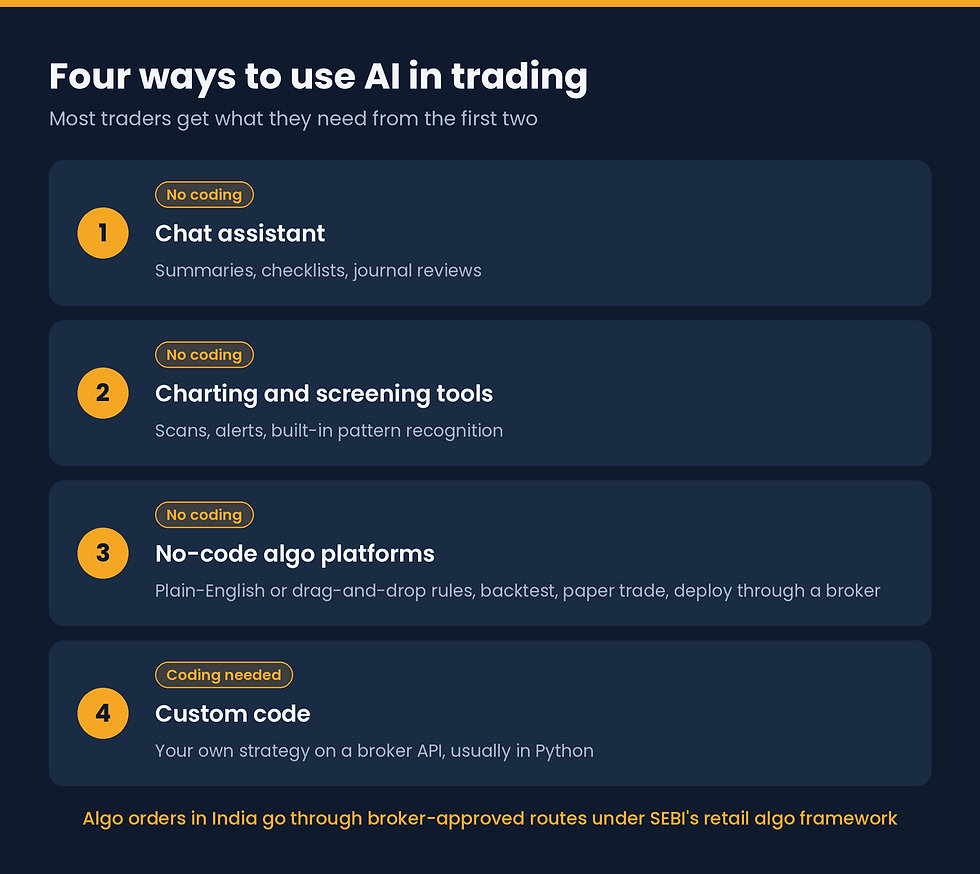
Most retail traders get almost all the benefit from levels 1 and 2. Level 3 makes sense only once you have a rule-based strategy that you already trade manually and want to automate.
Level 1: use a chat assistant as your research helper
Chat assistants are the easiest place to start. Paste in text you trust, such as a results press release, an annual report section or a concall transcript, and ask the assistant to work on that text. You get far better answers this way than by asking it general questions about a stock.
Good uses include summarising a company's quarterly results into five lines, listing the risks management mentioned on a call, comparing this quarter's margins with the last four, or turning your written rules into a pre-trade checklist.
Always ask for the exact line or page each number came from, and check a few of them yourself. Chat assistants sometimes invent figures that sound right. For anything involving live prices, use your charting platform, not the chatbot.
Level 2: charting, scanning and alerts
Many charting platforms and broker apps now include screeners, alerts and automatic pattern recognition. Used well, they save hours of flipping through charts.
The trick is to treat their output as a shortlist, not a signal. If a scanner flags a stock as forming a flag pattern, open the chart and check it against your own rules. Our guide to the flag and pole pattern shows the checks we use. Alerts are especially useful: mark your levels in advance, let the platform tell you when price gets there, and stay away from the screen the rest of the time.
Level 3: no-code algo platforms and SEBI's rules
No-code algo platforms let you describe a strategy in plain language, for example "buy when the 20-day average crosses above the 50-day average and RSI is above 50, with a 1.5% stop-loss", and turn it into rules you can backtest, paper trade and then run live.
In India, this sits under SEBI's circular on safer participation of retail investors in algorithmic trading, issued in February 2025. After a phased rollout, the framework applies to all stock brokers from 1 April 2026. The main points for a retail trader are:
Algo orders sent through a broker's API are tagged with an identifier issued by the exchange.
Third-party algo providers have to be empanelled with the exchanges and work as the broker's agents. The broker is responsible for them and handles complaints.
Brokers can no longer offer open APIs. Access is through client-specific API keys, with whitelisted static IPs and two-factor authentication.
Traders who write their own algos have to register them through their broker if they cross the order-per-second threshold set by the exchanges.
In practice, before you pay for any "AI bot" or strategy platform, ask your broker whether it is an approved route. If a provider asks for your trading password or OTP instead, walk away.
Backtests need care too. It is easy to tweak settings until past results look perfect, and those settings often fail in live markets. Include brokerage, taxes and slippage in every backtest, test on a period you didn't use to build the rules, and paper trade for a few weeks before risking money.
A simple weekly workflow using AI

Weekend research. Ask your assistant to summarise the week's results, economic data and the events calendar for the coming week. You pick the watchlist.
Plan the levels. Mark entry, stop-loss and target levels on your charts yourself, then set alerts so you don't have to watch all day.
Pre-trade check. Before each trade, run through the checklist the assistant helped you write. If any answer is no, skip the trade.
During market hours. Follow your plan. Don't ask a chatbot whether to buy or sell right now; it doesn't know.
Post-market journal. Write two or three lines on each trade: why you took it, what happened and how you felt.
Weekly review. Paste the week's journal into the assistant and ask which mistakes repeated. This step alone is where many of our students see the biggest change.
Prompts you can use today
Copy these, then adjust them to your own style. Replace the text in brackets.
"Here is the Q2 results press release for [company]. Summarise revenue, operating margin and net profit compared with the same quarter last year, and quote the line each number comes from."
"These are my trading rules: [paste rules]. Turn them into a yes/no checklist I can run before every trade."
"Here is my trade journal for this week: [paste]. Group my losing trades by the mistake behind them and tell me which mistake cost the most."
"Rewrite this strategy idea as exact rules a backtesting tool could follow, and list anything I haven't defined: [paste idea]."
None of these prompts asks the AI for a prediction. That is deliberate.
Risks and mistakes to avoid
The biggest one is asking AI for tips. A chatbot will happily name stocks and targets with full confidence, but it has no edge and, in most cases, no live data. Treat any buy or sell call from it as noise.
The second is trusting numbers without checking them. If a summary says profit grew 40%, open the source and confirm it before it shapes a decision.
Third, watch out for "AI bot" scams. Telegram and WhatsApp groups regularly promise fixed monthly returns from an AI system. No genuine trading system can promise that. Our Telegram trading scam guide shows the common patterns.
Fourth, protect your accounts. Never share your trading password, OTP or API secret with a tool or a person. For crypto bots that connect to an exchange through API keys, switch off withdrawal permissions. Crypto exchanges and bots aren't regulated by SEBI, so the protections above don't apply there.
And finally, don't automate a strategy you haven't traded by hand. Automation makes a good process faster; it makes a bad one lose money faster too.
For a hands-on comparison of individual tools, see our review of the best AI tools for trading in 2026.
AI in trading: a quick recap in Hindi
Trading mein AI use karne ke liye coding ki zaroorat nahi hai. ChatGPT jaise tools se results, news aur concall ka summary banwao, apne rules ki checklist banao, aur hafte ke end mein apna trading journal review karwao. Charting tools ke alerts aur scanners se shortlist banao, par final faisla chart dekh kar khud lo. AI se buy-sell tips mat maango, aur kisi bhi "AI bot" ko apna password, OTP ya API secret mat do. Algo trading broker ke approved route se hi karo, kyunki SEBI ke naye algo rules 1 April 2026 se sab brokers par lagu hain.
How we use AI in our courses
At Mentor Aditya Jain Academy, AI is used to save research time, not to pick trades. The Global Stock Market Course with AI includes a prompt pack for research, risk extraction, journaling and weekly reviews, and every decision still has to follow your written rulebook. The course comes with five years of access and updates, so the AI workflows are updated as the tools change. Doubts are answered by the Personal Guidance Desk on WhatsApp chat and phone.
The course itself goes from basics to advanced in order. We teach how institutions trade rather than the common strategies everyone already finds free online, since crowded setups are one reason many traders lose. Every strategy we teach is backtested, and students see the backtest.
Personal Guidance Desk on WhatsApp
A real person on our Personal Guidance Desk answers chats on the official WhatsApp (063-5033-9545), with no pressure to join. We respect your privacy. We never make spam or follow-up calls. If you prefer, call us on toll-free 1800-202-8034 or chat on WhatsApp 063-5033-9545. For a question about using AI in your trading, the free course, a paid course or anything else in trading, message the Personal Guidance Desk on WhatsApp.
Frequently asked questions
Do I need coding skills to use AI trading platforms?
No. Chat assistants, charting tools with AI features and no-code algo builders all work without code. You only need programming if you want to build your own strategy engine on a broker API.
Can AI predict stock prices accurately?
No tool predicts prices reliably. AI is useful for summarising information, scanning charts against fixed rules and reviewing your trades, but short-term price movements depend on news and order flow that no model can foresee consistently.
Is AI or algo trading legal in India?
Yes, through approved routes. Under SEBI's retail algo framework, applicable to all brokers from 1 April 2026, algo orders through broker APIs are tagged with an exchange-issued identifier, third-party providers must be empanelled, and your broker is responsible for the service. Check with your broker before using any algo provider.
How do I build an AI trading agent without coding?
Write your strategy as exact rules first: entry, exit, stop-loss and position size. Then use a no-code platform your broker supports to enter those rules in plain language or with visual blocks, backtest with costs included, paper trade for a few weeks and only then go live with small size.
Can I use ChatGPT for stock trading?
Yes, as a research and discipline tool. It works well for summarising results, building checklists and reviewing your journal. Don't use it for buy or sell calls, and verify any number it gives you against the original source.
Which AI tool is best for beginners in trading?
Start with a general chat assistant and the alerts and screeners in your charting platform or broker app. They're cheap or free, need no setup and cover most of what a beginner needs. Move to algo platforms only after you have a strategy you already trade manually.
Is AI trading profitable?
AI doesn't make a strategy profitable on its own. If your rules and risk management are sound, AI can save time and reduce mistakes. If they aren't, automation simply repeats the losses faster.