Best Free Stock Market Course in India for Beginners (Fundamental + Technical)
Quick answer: A good free stock market course for beginners should be structured, start from zero, use real Indian examples and teach risk management, with no tips and no pressure to upgrade. Our free course from Mentor Aditya Jain Academy has two parts: a 9-module fundamental series that teaches you to audit a stock the way an institutional analyst would, and an 8-module technical analysis and price action series. It's pre-recorded, in simple Hindi with easy English, and costs nothing. There's no certificate for the free course at the moment.
Quick disclosure: this is our own blog, and the course reviewed here is ours. The checklist in the first section works for any free course.
Search "free stock market course" and you'll find hundreds of playlists, PDFs and "free webinars" that end in a sales pitch. Some are genuinely useful. Many skip the boring parts, like reading a balance sheet or sizing a position, which are the parts that keep beginners from losing money.
About this guide: it's written by the Mentor Aditya Jain Academy team in Jaipur. We teach trading as education only and don't give tips or buy and sell calls.
What makes a free stock market course worth your time
Before you spend 20 or 30 hours on any free course, check these:
A clear curriculum. You should be able to see every module before you start, in a sensible order.
It starts from zero. Demat accounts, IPOs and basic ratios before candlestick patterns.
Fundamentals and technicals both. Charts alone tell you when; company numbers tell you what you're buying.
Real examples. Indian companies and real charts, not textbook diagrams.
Risk management. Stop-losses, position size and paper trading should be in the course, not an afterthought.
No tips, no calls. A course teaches you to decide. A tip channel decides for you.
Honest about limits. Whether there's a certificate, how long access lasts and what's held back for paid courses should be stated up front.
What's inside our free stock market course
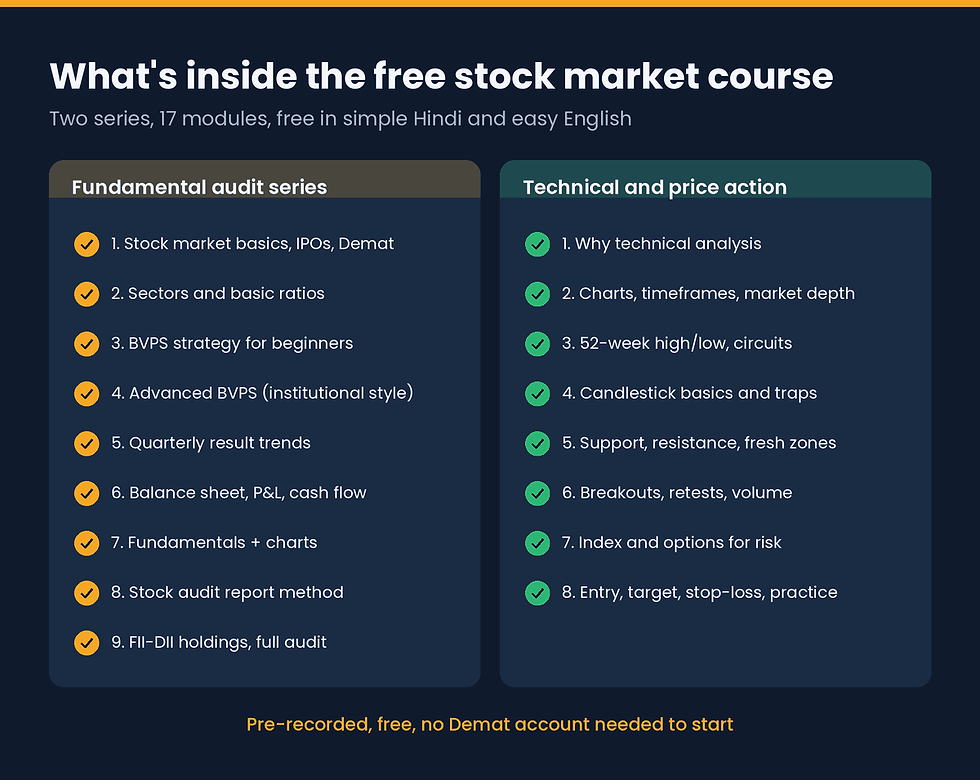
The course has two mini-programs. You can take them in either order, but most beginners do the fundamental series first.
Free course 1: Fundamental and institutional audit series (9 modules)
This series teaches you to read a company the way an analyst at an institution would, and to write a one-page audit before you invest.
Module 1: Introduction to the stock market, IPOs, Demat accounts and basic terms
Module 2: Market structure, sectors and basic ratios such as market cap, PE, EPS and dividends
Module 3: Book value per share (BVPS) strategy for beginners, with a fair value calculation
Module 4: Advanced BVPS strategy: how institutions look at book value, debt and assets
Module 5: Quarterly result trends, with SAIL and IOC as case studies
Module 6: Balance sheet, P&L and cash flow, using Reliance Industries and Yes Bank
Module 7: Combining fundamentals with charts, with a Wipro case study
Module 8: The stock audit report method, with IndiaMart, Alok Industries, SpiceJet and Jet Airways
Module 9: FII and DII holdings, promoter stake and a full stock audit on HUDCO
Free course 2: Technical analysis and price action (8 modules)
This series is about charts and behaviour: how prices move, how institutions create trends, and how to plan entries, targets and stop-losses.
Module 1: Why technical analysis, and how it connects to the fundamental series
Module 2: Charts, timeframes and market depth, including how big players place orders
Module 3: 52-week highs and lows as demand and supply zones, and circuit limits
Module 4: Candlestick basics, rejection candles and traps
Module 5: Support, resistance, and fresh versus already-tested zones
Module 6: Breakouts, retests and volume confirmation, including fake breakouts
Module 7: Nifty, Bank Nifty and options used as insurance, not as a bet
Module 8: A rule-based entry plan, trailing stop-loss, paper trading and journaling
What "institutional-style" means in this course
Mentor Aditya Jain Academy teaches institutional trading strategy: how institutions and other large participants analyse companies, build positions and manage risk, rather than tips or single indicators. In the free course, that shows up in three ways.
Audit before you buy. Instead of buying on a tip, you check sales and profit trends, the balance sheet, book value and FII and DII holdings, and write it down on one page.
Read the footprints. You learn how large orders show in market depth and volume, why fresh demand and supply zones matter more than levels that have already been tested, and why so many breakouts fail.
Plan the risk first. Every trade idea gets an entry, a target and a stop-loss before you place it, and you practise on paper before using money.
It won't make you a professional trader in a month. It gives you a rule-based base to build on.
How to get free access (web and app)
Open the Free Stock Market Course in India page.
Click Enroll Now under the series you want, sign up with your email and verify it.
Both series appear in your dashboard. You can also watch them in the official Android app (Google Play) by logging in with the same email.
You don't need a Demat account to start. The course explains what a Demat account is and what to check before you open one.
Who this free course is for
College students and complete beginners who've never read a chart or a balance sheet
Working professionals who want a structured course they can watch in short sessions
Traders who've lost money following tips and want to understand what they're buying
Anyone thinking about a paid course who wants to test the teaching style first
Free course vs paid course
Free course | Paid courses | |
Cost | ₹0, no hidden charges | Paid |
Content | Fundamentals, stock audit, price action basics | Full institutional framework: stock audit, advanced demand-supply price action, F&O Greeks and hedging, AI research tools |
Format | Pre-recorded | Course, recorded lessons, live classes, assignments and 5 years of updates, all in one program from your join date, plus live doubt clearing |
Practice | Self-study, paper trading | Monthly assignments (the Personal Guidance Desk checks your answers), templates and tests |
Certificate | Not at the moment | Completion certificate |
Support | Toll-free number and WhatsApp for course queries | Personal Guidance Desk on WhatsApp chat and the toll-free line |
A simple 4-week study plan
Week 1: Fundamental modules 1 to 5. Pick one company you know and note its last eight quarters of sales and profit.
Week 2: Fundamental modules 6 to 9. Write a one-page audit of that company, including FII and DII holdings.
Week 3: Technical modules 1 to 5. Mark support, resistance and fresh zones on the same company's chart.
Week 4: Technical modules 6 to 8. Paper trade three setups with a written entry, target and stop-loss, and journal the result.

If you can finish this plan and explain each of your paper trades, you're ready to decide if you need a paid course at all.
Is there a free stock market course with a certificate?
Many searches ask for a free course with a certificate. Ours doesn't offer one right now; the course page says that if a digital certificate is added later, it'll be stated there. Be careful with "free certificate" offers in general: a certificate proves attendance, not skill. What matters is that you can analyse a stock and manage risk on your own.
Free stock market course in Hindi: a quick recap
Ye free stock market course beginners ke liye hai aur bilkul free hai, koi hidden charge nahi. Isme do series hain: 9 modules ki fundamental aur institutional audit series, jisme aap company ka one-page audit banana seekhte ho, aur 8 modules ki technical analysis aur price action series, jisme support-resistance, breakout-retest aur stop-loss planning hai. Classes pre-recorded hain, simple Hindi aur easy English mein. Abhi free course ke saath certificate nahi hai. Shuru karne ke liye Demat account zaroori nahi hai.
Learning further with us
Mentor Aditya Jain Academy teaches learners across India in free and paid courses. If the free course clicks for you, the next step is the Global Stock Market Course with AI, which goes deeper into institutional stock audits, advanced demand-supply price action and F&O risk management.
That's how the path is built: the free course gives you the basics, and the paid course takes you into advanced institutional work. Neither one is about the common setups everyone already trades, because when the whole crowd uses the same strategy, most of them lose. The strategies are backtested, and we show students the backtest.
Paid courses come with five years of course access and updates, so the lessons keep up as markets and AI tools change. Doubts are answered by the Personal Guidance Desk on WhatsApp chat or by phone.
Personal Guidance Desk on WhatsApp
A real person on our Personal Guidance Desk answers chats on the official WhatsApp (063-5033-9545), with no pressure to join. We respect your privacy. We never make spam or follow-up calls. If you prefer, call us on toll-free 1800-202-8034 or chat on WhatsApp 063-5033-9545. If something about one of the free lessons isn't clear, you're deciding between the free course and a paid course, or you have any other trading question, send it to the Personal Guidance Desk on WhatsApp.
Frequently asked questions
Is this stock market course really free?
Yes. Both series are free to watch online, with no hidden charges and no card needed. You decide later, if at all, whether to join a paid course.
Is this free course suitable for complete beginners?
Yes. It starts with what the stock market is, how IPOs and Demat accounts work and how to read simple ratios. You don't need any trading or investing experience.
Do I get a certificate with the free stock market course?
Not at the moment. The free course is designed for learning. If a digital certificate is added later, it will be mentioned on the course page. Completion certificates are issued for paid courses.
In which language is the free course taught?
The lessons are in simple Hindi mixed with easy English, so learners from different backgrounds can follow them.
What does institutional trading strategy mean at Mentor Aditya Jain Academy?
It means learning how institutions and large participants analyse companies, build positions and manage risk: auditing a stock before buying, reading demand and supply zones and market depth, tracking FII and DII holdings, and planning every trade's stop-loss first. The free course introduces these ideas and the paid courses cover them in depth.
Do I need a Demat account to start?
No. You can complete the free course without one. The course explains what a Demat account is and what to check before opening one.
Do I have to join a paid course after the free course?
No. The free course stands on its own. If you later want assignments, templates and the full institutional process, the paid courses are there, but there's no obligation.
Do you give stock tips in the free course?
No. Mentor Aditya Jain Academy is an educational institute, not an advisory. There are no tips, calls or guaranteed returns.