Best Mentor for Zinc Trading in India (2026): What a Base Metals Teacher Should Cover
Updated: Nov 16, 2025
Quick answer: A good zinc trading mentor teaches you that MCX zinc follows the London Metal Exchange (LME) price, Chinese demand, steel galvanising and the rupee, and shows you how to size trades on MCX's 1 tonne Zinc Mini before moving to the 5 tonne contract. Look for written rules, fixed risk per trade and no tips. Very few teachers specialise in zinc alone, so a broader base metals or commodity mentor is usually the realistic choice.
Zinc rarely makes headlines. That's part of its appeal for some traders, and part of the risk: it can sit quietly for days and then move hard on a China data surprise or an LME stock change. You need to know why it moves, not just where the chart lines are.
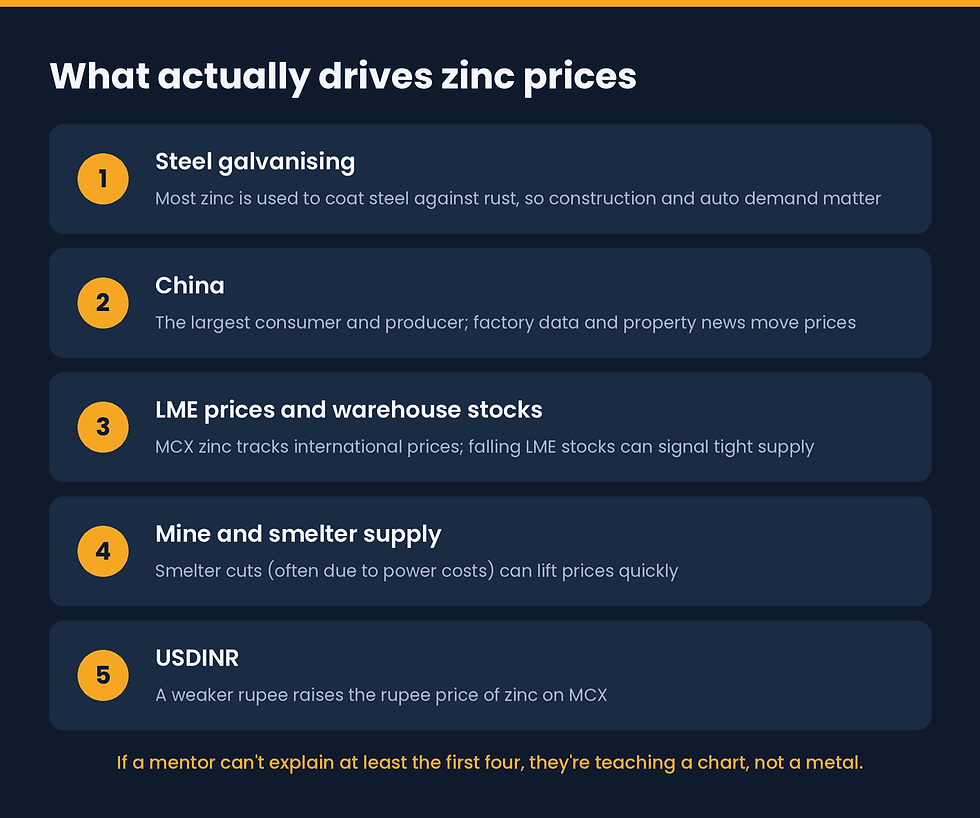
What actually drives zinc prices
Driver | Why it matters |
Steel galvanising | Most zinc is used to coat steel against rust, so construction and auto demand matter |
China | The largest consumer and producer; factory data and property news move prices |
LME prices and warehouse stocks | MCX zinc tracks international prices; falling LME stocks can signal tight supply |
Mine and smelter supply | Smelter cuts (often due to power costs) can lift prices quickly |
USDINR | A weaker rupee raises the rupee price of zinc on MCX |
If a mentor can't explain at least the first four, they're teaching a chart, not a metal.
How MCX zinc contracts work
MCX lists Zinc (5 metric tonnes) and Zinc Mini (1 metric tonne), both quoted in rupees per kg. A ₹1 move per kg is worth ₹1,000 on the mini and ₹5,000 on the big contract. That's why a beginner should start with the mini, or with paper trades. Check the current contract specifications and margins on MCX before you trade.
What a zinc or base metals mentor should teach
How to read LME and China data releases, and which ones matter.
How zinc moves with copper, aluminium and lead, and when it doesn't.
One setup, written down, with entry, stop and size defined before the trade.
A maximum loss per trade (1 to 2% of capital is a common rule).
Expiry, rollover and the delivery-linked nature of MCX base metal contracts.
A trade journal and monthly review.
Questions to ask before you join
Good test questions are specific. Ask what zinc did the last time China released weak factory data, and how they would have traded it. A real base metals teacher will have an answer, or at least reason it through in front of you. Ask which contract you should start with on a ₹1.5 lakh account; the reply shows whether they think about position size at all. It's also worth asking when they stay out of zinc altogether, since a mentor who trades it in every condition is teaching a habit, not judgement.
Then ask straight out whether they give calls or levels. A mentor who only teaches should say no.
Red flags
"Zinc is a silent money maker" or other promises of quiet, steady profits.
Student testimonials claiming dramatic improvement, with no way to verify them.
Advice to trade the 5 tonne contract on a small account.
Where Mentor Aditya Jain Academy fits
Zinc is covered as part of the International Commodity Market Course with AI, with other metals, energy and bullion, using demand-supply price action, global drivers and fixed risk rules. It's taught online in Hindi and English, with no tips. It isn't a zinc-only programme.
The course is a step-by-step path from basics to advanced. It avoids the common strategies anyone can find free online, because when everybody uses the same ones, most people lose. What it teaches is how institutions trade, kept up to date, with every strategy backtested and the backtest shown to students.
Related reading: how to choose a commodity trading mentor, gold trading mentor guide and commodity market institutes in India.
Paid students get five years of course access and updates. Support is through WhatsApp chat or the toll-free line, and the replies come from the Personal Guidance Desk.
Personal Guidance Desk on WhatsApp
A real person on our Personal Guidance Desk answers chats on the official WhatsApp (063-5033-9545), with no pressure to join. We respect your privacy. We never make spam or follow-up calls. If you prefer, call us on toll-free 1800-202-8034 or chat on WhatsApp 063-5033-9545. For a question about zinc trading, the free course, a paid course or anything else in trading, message the Personal Guidance Desk on WhatsApp.
Frequently asked questions
Who is the best mentor for zinc trading in India?
There's hardly anyone who teaches zinc alone. Look for a commodity or base metals mentor who explains LME prices, China demand and the rupee, teaches MCX contract sizing and risk rules, and doesn't give tips. Compare two or three using the questions above.
Can beginners learn zinc trading?
Yes, if they first learn chart basics, stop losses and position sizing. Then start with the 1 tonne Zinc Mini or paper trading, and follow China and LME data for a few weeks before risking money.
What makes Mentor Aditya Jain's approach to zinc different?
Zinc is taught as part of a wider commodity course that links price action to global drivers like LME data, China and the dollar-rupee rate, with fixed risk rules and no tips. You can judge the teaching style with the free stock market course before deciding.
Which is better for beginners: zinc or gold?
Neither is easy. The MCX Gold Petal and Gold Guinea contracts are very small, so gold lets you learn with less money at risk. Zinc Mini is larger in rupee terms. Start with whichever you understand better, at the smallest size.
About this guide
Published by Mentor Aditya Jain Academy.

