Best Stock Market Mentor in India (2026): How to Choose the Right One
Updated: Oct 8
Quick answer: The best stock market mentor for you is one who teaches a written process with clear risk rules, uses old examples instead of live tips, and lets you sample the teaching for free before you pay. Follower counts, profit screenshots and "Top 5" lists tell you very little.
The checklist works the same on any mentor.
Search "best stock market mentor in India" and you get a page full of people calling themselves the best. Some are good teachers. Some are tip sellers with a course attached. A few are outright scams. You can't tell them apart from the thumbnail, so here is a way to check before any money leaves your account.
What a stock market mentor actually does
A mentor teaches you how to make decisions: how to read a chart or a balance sheet, when to stay out, how much to risk on one trade, how to review your mistakes. The goal is that one day you don't need them.
A tip provider does the opposite. They tell you what to buy, and you stay dependent on the next message.
There is also a legal line here. Someone who is only an educator is not allowed to give advice or make claims about returns. Since 1 July 2026, an educator also can't name a stock using price data from the last 30 days in a way that hints at where it will go next. Before that, under SEBI's January 2025 circular, the gap was three months. You can read the current rule in SEBI's May 2026 circular on price data for education.
So a genuine educator who says "I can't tell you whether to buy this stock today" is following the rules, not dodging your question.
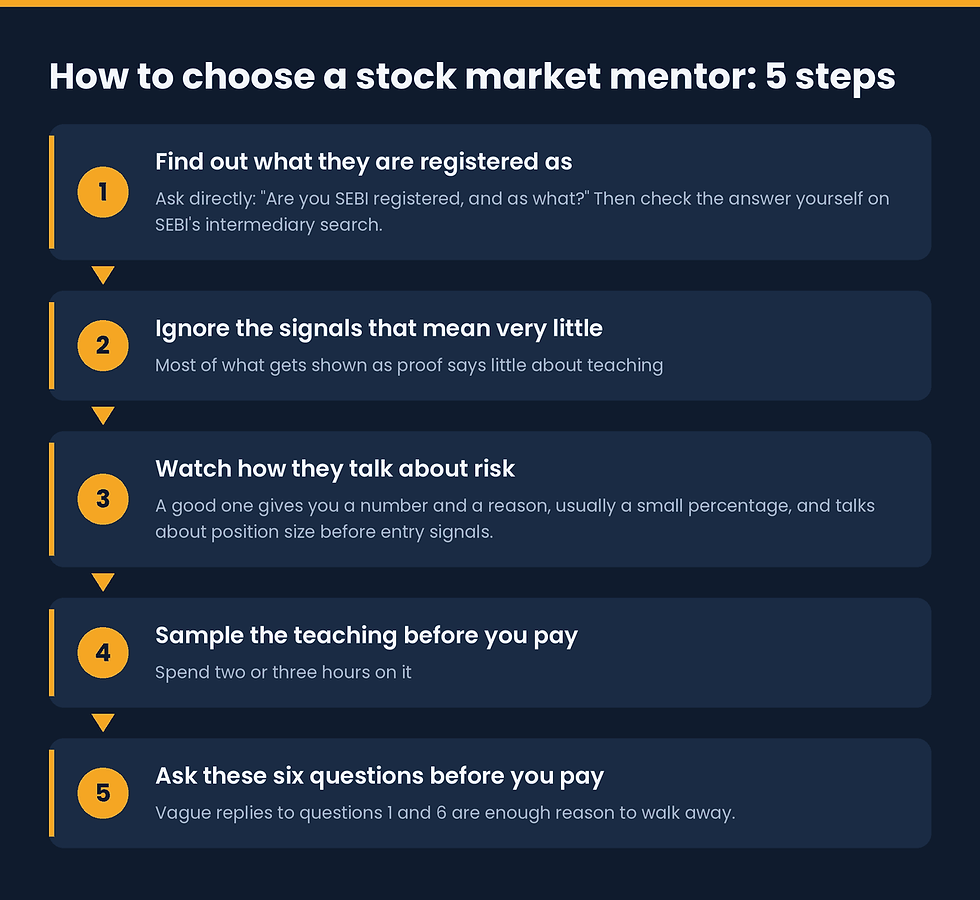
Step 1: Check that they only teach
Ask directly whether they give tips, calls or buy and sell levels anywhere, including Telegram or WhatsApp. A mentor who only teaches should say no, and stick to it.
The answer that should worry you is an "educator" whose Telegram channel posts entry, target and stop-loss every morning.
Step 2: Ignore the signals that mean very little
Most of what gets shown as proof says little about teaching.
Profit screenshots are the obvious one. Anyone can post winners and quietly leave out the losers, and educators aren't even supposed to make return claims. A big follower count mostly tells you someone is good at YouTube or Instagram. That's a real skill, just not the one you're paying for.
"Top 5 mentors" articles work the same way. A media feature shows reach, not how well someone teaches. Read the whole article page, including any notes at the end, and still sample the teaching. We've been mentioned in such articles too; here's what they say.
As for cars, offices and lifestyle reels, they aren't evidence of anything you need.
Step 3: Watch how they talk about risk
This is the fastest filter. Ask a mentor how much of your capital you should risk on one trade. A good one gives you a number and a reason, usually a small percentage, and talks about position size before entry signals.
SEBI's own numbers explain why. Its study of FY25 found that 91% of individual traders in equity F&O made a net loss, and the average loss was about ₹1.1 lakh per person. A mentor who skips risk and jumps to "my Bank Nifty expiry setup" is teaching you to join that 91%.
Step 4: Sample the teaching before you pay
Almost every serious educator has free material: YouTube lessons, a free course, a webinar. Spend two or three hours on it and ask yourself:
Did I understand why a setup works, not just where to click?
Did they show losing trades or only winners?
Was there homework, or just motivation?
Would I be comfortable asking this person a basic question?
If the free material is all hype and "join the paid batch to learn the real secret", the paid material is usually the same thing, longer.
Step 5: Ask these six questions before you pay
What exactly is in the syllabus, module by module?
How are doubts answered, and how fast?
Is it recorded, live, or both? If live, at what times?
What do I get after the course ends: updates, community, nothing?
What is the refund policy, in writing?
Do you give trade calls or tips anywhere, including Telegram?
Write the answers down. Vague replies to questions 1 and 6 are enough reason to walk away.
A simple scorecard to compare mentors
What to check | What good looks like | Red flag |
Risk teaching | Position sizing and max loss come early | "Risk is for losers", all-in setups |
Examples | Older charts, losing trades shown | Only live picks and profit screenshots |
Free sample | Real lessons you can learn from | Teasers that end with "buy to know more" |
Support | Defined doubt-clearing method | "DM me", no response time |
Pricing | One clear fee, written refund policy | Countdown timers, "only 3 seats left" |
Score each row 0, 1 or 2. Anything under 8 out of 12 isn't worth your money yet.
Red flags that should end the conversation
Guaranteed or "fixed monthly" returns.
Asking for your trading login or to "manage your account".
Pressure to borrow money or move to a "VIP" paid tip group.
A Telegram channel with no name, no company and no address. Our guide to spotting fake Telegram trading channels covers this in detail.
Teaching that leans on hot small caps with sudden volume. That's often operator activity, not a lesson.
Where Mentor Aditya Jain fits
The academy is an education company based in Jaipur. It doesn't give tips or advisory calls. Its courses are online and cover Indian and global stocks with F&O, commodities and crypto, taught in a Hindi and English mix. Course, recorded lessons, live classes, assignments and 5 years of updates, all in one program from your join date. Live doubt-clearing sessions are included. There is a free stock market course you can use to judge the teaching style with the steps above, and you can read more about Mentor Aditya Jain's background. Apply the same scorecard to us that you would to anyone else.
On method: the academy teaches in a structured path from basics to advanced, and it doesn't teach the common strategies that are freely available online, because when everyone trades the same way, most of them lose. It teaches institutional strategies, meaning how large institutions trade, updated for the current market. Each strategy is backtested and the backtest is shown to students, so you can check it instead of taking our word for it.
If you want named options to compare, see our 2026 list of stock market mentors in India. Not sure you need a mentor at all? Read do you need a stock market mentor first.
Paid courses come with five years of access and updates; methods change as tools and AI change, so the content gets revised rather than repeated. Support, on the official WhatsApp chat or by phone, comes from the Personal Guidance Desk. Course page: Global Stock Market Course with AI.
Personal Guidance Desk on WhatsApp
A real person on our Personal Guidance Desk answers chats on the official WhatsApp (063-5033-9545), with no pressure to join. We respect your privacy. We never make spam or follow-up calls. If you prefer, call us on toll-free 1800-202-8034 or chat on WhatsApp 063-5033-9545. Questions about choosing a mentor, the free course, a paid course or any other trading topic can go straight to the Personal Guidance Desk on WhatsApp.
Frequently asked questions
Who is the best stock market mentor in India?
There isn't one answer for everybody. The right mentor depends on what you want to learn (investing, swing trading, F&O) and how you learn. Use the scorecard above: risk taught early, honest examples, free material you can test, and a clear fee and refund policy.
How much does a stock market mentor cost in India?
It varies a lot. Good free material exists, and paid courses and one-on-one mentoring range widely in price. For reference, the paid courses at Mentor Aditya Jain Academy cost ₹14,999 each including GST, with 5 years of course access and updates, and its foundation course is free. Whatever you choose, get the fee and refund terms in writing.
Does a course certificate matter?
Only a little. A completion certificate shows you finished a course; it isn't a licence and it doesn't prove skill. If you want a recognised credential, NISM certifications are the standard in the Indian securities market.
Who is Mentor Aditya Jain and why is he called a mentor?
Mentor Aditya Jain is a trading educator and the founder of Mentor Aditya Jain Academy in Jaipur. "Mentor" is part of the academy's name. The academy teaches institutional-style analysis, price action, F&O risk and the use of AI tools, as education only, without tips or advisory services.
About this guide
Published by Mentor Aditya Jain Academy.

