Where to Learn F&O Trading Online in India: What a Good Course Should Teach
Updated: Nov 16, 2025
Quick answer: The best place to learn F&O trading online is a course that teaches risk before strategies: how futures and options are priced, what the Greeks and implied volatility tell you, how to size a position from its stop-loss, and how to hedge, all with a written rulebook. Avoid anything built around expiry-day tips or "guaranteed" option setups. Mentor Aditya Jain Academy teaches F&O as the third pillar of its institutional process, covering Greeks, IV and hedging, inside the Global Stock Market Course with AI.
Futures and options attract traders because a small amount of money controls a large position. That same leverage is why most people lose. SEBI's own studies found that 93% of individual F&O traders lost money between FY22 and FY24, and 91% still lost money in FY25. So the real question isn't where to find the next options strategy. It's where to learn F&O in a way that keeps you out of that 91%.

About this guide: it's written by the Mentor Aditya Jain Academy team in Jaipur. We teach futures and options trading as education only and don't give tips or buy and sell calls.
What F&O trading actually involves
Futures are contracts to buy or sell an index or stock at a set price on a future date. Gains and losses move one-for-one with the underlying, on the full contract value, not just your margin.
Options give the buyer the right, but not the obligation, to buy (call) or sell (put) at a strike price. Buyers pay a premium. Sellers collect it and take on the bigger risk.
Contract sizes are large. Since November 2024, index derivative contracts must be worth at least ₹15 lakh, so one lot can move by thousands of rupees in a normal session.
That's why risk management isn't a module you finish later. It has to come first.
What a good online F&O course should teach
Check that these are covered properly before you pay for any course:
Pricing basics. How futures track the underlying, and what goes into an option's premium.
The Greeks in practice. Delta, gamma, theta and vega, and what each one does to your position as price, time and volatility change.
Implied volatility. Why options get expensive before events, and why buying them then often loses even when you're right on direction.
Position sizing. Working out lot size from where your idea is wrong, not from the margin your broker allows.
Hedging. Using options as insurance on a futures or stock position, and knowing what that insurance costs.
A scenario plan. What you'll do if price goes up, down or nowhere, decided before you enter.
How large players behave. Where stop-losses bunch up, why expiry days behave differently, and why the option chain isn't a forecast.
If a course skips most of this and goes straight to "high-accuracy" setups, keep looking.
What a hedge changes
Here's the simplest example of institutional-style risk control. Suppose you buy a futures position at 100. If price falls to 80, you lose 20 points, and nothing stops it going further. Now suppose you also buy a put with a strike of 100 for a premium of 4. Below 100, the put gains what the futures lose, so your worst case is the 4 you paid. Above 100, you still make money, just 4 points less, because that's the cost of the insurance.
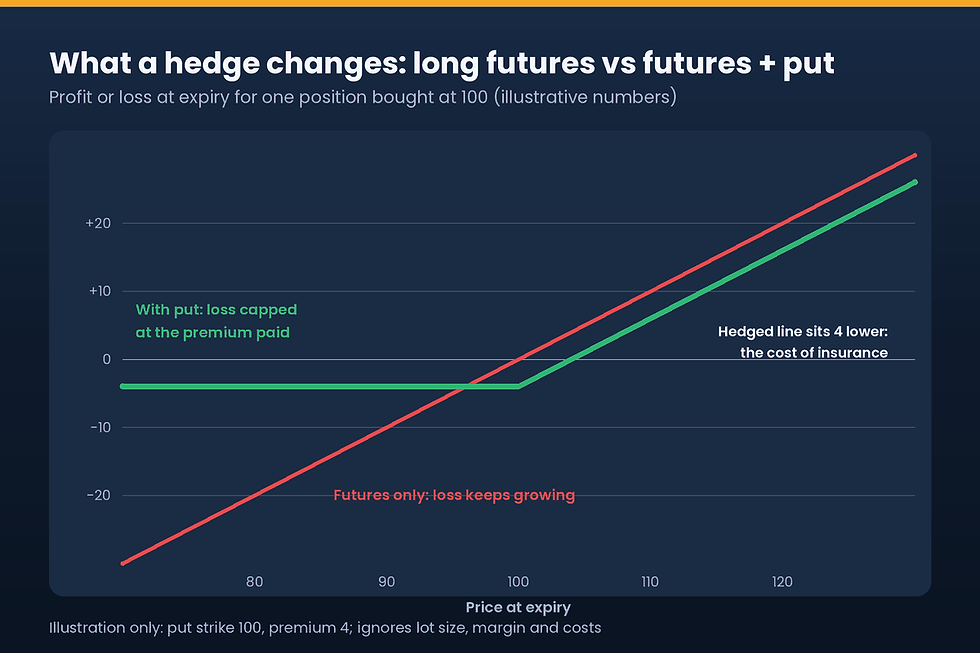
Large participants think this way all the time: decide the worst case first, pay for protection when it's worth it, and size the position so one bad day can't end the year. For the Greeks themselves, our option Greeks beginner guide explains each one with examples.
How we teach F&O at Mentor Aditya Jain Academy
Mentor Aditya Jain Academy teaches institutional trading strategy in three pillars, and F&O is the third. It builds on the first two: institutional-style fundamentals and pure price action with Advanced Demand–Supply zones. The F&O pillar covers:
Delta, gamma, vega and theta in practice, plus IV, skew and term structure
Directional and neutral overlays on top of your price action view
Insurance and hedge structures for positions you want to protect
A scenario builder with rules to plan and adjust trades, without over-fitting
An F&O scenario sheet template you fill in before every position
AI is used for payoff sanity checks, checklists and trade debriefs. It saves time but doesn't decide your trades. To see the traps this process is designed to avoid, read how institutions trap retail F&O traders.








Online vs offline: why online works for F&O
Markets don't care where you sit. An online course lets you replay a lesson on Greeks as many times as you need, study around a job, and ask doubts during live doubt-clearing sessions. Course, recorded lessons, live classes, assignments and 5 years of updates, all in one program from your join date. Lessons are in a mix of Hindi and English, with a students-only education channel and monthly assignments that the Personal Guidance Desk checks.
About Mentor Aditya Jain
Mentor Aditya Jain is the founder and CEO of Mentor Aditya Jain Academy in Jaipur. He has conducted stock market fraud-awareness training for the Rajasthan Police. The academy has learners across India in free and paid courses, and it's an educational institute only: no tips, no calls.
F&O trading course in Hindi: a quick recap
F&O mein chhote margin se bada position banta hai, isliye zyada log nuksaan karte hain. SEBI ke data ke hisaab se FY25 mein 91% individual F&O traders ko loss hua. Achha course pehle risk sikhata hai: Greeks, implied volatility, stop-loss se lot size, aur put se hedge. Mentor Aditya Jain Academy F&O ko institutional process ke teesre pillar ki tarah sikhati hai. Tips ya expiry calls nahi.
Learning F&O with us
If you're new to the market, start with the free stock market course. The full F&O pillar, together with fundamentals and price action, is part of the Global Stock Market Course with AI.
The F&O lessons run in order, starting with the basics and moving to advanced option work. We don't teach the common F&O strategies that everyone copies from free videos; that sameness is one reason so many traders lose. You learn how institutions trade derivatives, kept up to date, and each strategy is backtested, with the backtest shown to you.
Paid students get five years of course access and updates. Doubts are handled by the Personal Guidance Desk on the official WhatsApp chat or by phone.
Personal Guidance Desk on WhatsApp
A real person on our Personal Guidance Desk answers chats on the official WhatsApp (063-5033-9545), with no pressure to join. We respect your privacy. We never make spam or follow-up calls. If you prefer, call us on toll-free 1800-202-8034 or chat on WhatsApp 063-5033-9545. For a question about futures and options, the free course, a paid course or anything else in trading, message the Personal Guidance Desk on WhatsApp.
Frequently asked questions
Where can I learn F&O trading online in India?
Choose an online course that teaches Greeks, implied volatility, position sizing and hedging with a written rulebook, not expiry-day tips. Mentor Aditya Jain Academy teaches F&O this way inside the Global Stock Market Course with AI.
Is F&O trading suitable for beginners?
Only after the basics. Learn how the market works and how to size positions first, then move to futures and options with small size or paper trades.
Why do most F&O traders lose money?
Leverage, oversized positions and buying options when they're expensive. SEBI found that 91% of individual F&O traders lost money in FY25.
Do you teach option Greeks and hedging?
Yes. Delta, gamma, vega and theta, implied volatility, and insurance and hedge structures are part of the F&O pillar, with a scenario sheet for every position.
Do you give F&O tips or expiry calls?
No. Mentor Aditya Jain Academy is an educational institute, not an advisory. It doesn't give tips, calls or guaranteed returns.
How long do I get access to the course?
Five years of course access and updates, plus recorded lessons, live classes and live doubt clearing.
